AI is changing how companies hire, but by supporting recruiters, not replacing them. Here's what's actually happening.
Artificial intelligence has become a familiar part of modern recruitment. You've probably heard terms like ATS (Applicant Tracking System), automated screening, or AI-powered interviews and wondered what they actually mean for your application. The reality is more straightforward and less daunting than the headlines often suggest.
AI isn’t making hiring decisions. Employers still are, but they are utilising AI to handle time-consuming administrative tasks, so that recruiters and hiring managers can focus their time on the parts of the process that need human judgement: meeting candidates, assessing culture fit, and making informed decisions about who to hire.
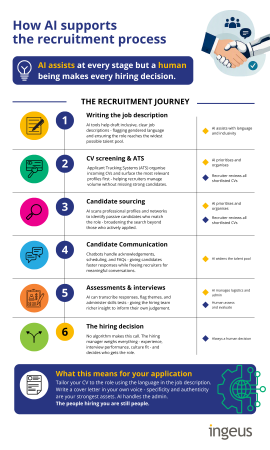
To help illustrate, this infographic breaks down what AI does in the hiring process and highlights the human expertise that remains at the heart of hiring decisions.
Why employers are turning to AI in recruitment
Recruitment is resource-intensive. A single job posting at a well-known employer can attract hundreds or even thousands of applications. Without some way to manage that volume, recruiters would spend most of their time on administration rather than on meaningful conversations with candidates.
AI tools help with this. They handle the repetitive, time-consuming elements of recruitment – sorting CVs, scheduling interviews, answering candidate questions, so that the human team can focus their energy where it counts.
How employers use AI
-
Writing better job descriptions
AI involvement often starts before candidates begin applying. Many employers use AI-assisted tools to draft and refine job descriptions, helping to ensure they are clear, inclusive, and free from language that might unintentionally put off applicants.
Some platforms analyse job descriptions for gendered phrasing or unnecessarily complex requirements, helping companies attract a broader and more diverse range of candidates from the outset.
-
CV Screening and Applicant Tracking Systems (ATS)
This is the stage where AI has the most direct impact on candidates, and it's worth understanding how it works.
Applicant Tracking Systems (ATS) are software platforms - tools like Greenhouse, Workday, or Lever that help recruitment teams organise and manage applications. Most medium and large employers use one. When you submit your CV, it's logged in the ATS, where AI can help prioritise applications based on how well they match the role's requirements.
Crucially, this is a tool to help recruiters manage their workload, not a system that automatically accepts or rejects candidates. A recruiter still reviews the applications, the AI simply helps them work through a large volume more efficiently by surfacing the most relevant profiles first.
The practical takeaway for candidates is simple: tailor your CV to the role. Use clear, straightforward language, include the key skills and experience mentioned in the job description, and avoid unusual formatting that might not display correctly in these systems. For example, use standard section headings such as Work Experience, Education and Skills, stick to common fonts, and avoid placing important information inside text boxes, tables, graphics, images or columns, as some systems can struggle to read these correctly.
-
Candidate sourcing
Beyond reviewing inbound applications, some employers use AI-powered tools to proactively search for candidates who might be a good fit for a role.Scanning LinkedIn profiles, professional portfolios, and other public sources.
This is particularly common for specialist or senior roles where the right candidate may not be actively job hunting. AI helps recruiters cast a wider net than would be possible manually, identifying people who match a role's requirements even if they haven't applied.
-
Chatbots and automated messaging
If you've applied for a job and received an instant reply with a few questions about your availability or eligibility to work, you've likely interacted with a recruitment chatbot.
These tools handle the early administrative side of communication - acknowledging applications, gathering basic information, answering common questions about the role or company, and arranging interview times. They're designed to give candidates a faster, more responsive experience, rather than leaving people waiting days for an acknowledgement.
The chatbot handles logistics. The recruiter handles everything that requires real conversation and judgement.
-
Video interviews and digital assessments
Some employers, particularly those hiring at graduate or early-career level, use structured video interview platforms as part of their process. Candidates record answers to set questions, which are then reviewed by the hiring team.
In some cases, AI tools assist by transcribing responses or flagging key themes, helping recruiters work through a high volume of recorded interviews more efficiently. A human reviewer still watches and assesses the interviews .The AI is there to support that process, not to make hiring decisions on its own.
Similarly, online skills assessments and psychometric tests are increasingly used to give employers a consistent, objective view of candidates' abilities. These are reviewed as one input among several, alongside CVs, interview performance, and other factors.
-
Interview scheduling and logistics
One of the most straightforward and genuinely useful applications of AI in recruitment is simply organising calendars. Coordinating interview times between multiple candidates and several members of a hiring team is surprisingly complex. AI scheduling tools remove the back-and-forth, offering candidates available slots and confirming bookings automatically.
It's a small detail, but it meaningfully speeds up the process for everyone.
Do job applications check for AI?
This question comes up a lot, particularly as tools like ChatGPT have made AI-assisted writing more accessible.
Some employers, particularly for roles where written communication is a core skill, do use AI detection tools to review covering letters and written submissions. This is more common in sectors like marketing, journalism, law, and graduate recruitment, where the ability to write clearly and authentically is part of what's being assessed.
That said, most employers aren't running every application through detection software. What they are familiar with, often without needing any tool, is an application that feels generic, impersonal, or disconnected from the specific role and organisation. A covering letter that could have been written for any job rarely makes a strong impression.
The most effective approach is to use AI as a helpful tool to improve clarity, check structure, or refine a draft, while ensuring your application reflects your own voice and genuine interest in the role. The personal details that make an application compelling: why this company, why this role, what specifically draws you to it, are things only you can provide.
What this means for your job search
Understanding how AI fits into recruitment processes takes away some of the mystery and helps you approach applications more strategically.
Tailor your CV for each role. ATS tools prioritise relevance. A well-targeted CV that mirrors the language and requirements in the job description will always perform better than a generic one.
Write a covering letter that sounds like you. Generic applications are easy to spot for humans and AI alike. Specificity and authenticity are your biggest advantages.
Don't be put off by automated steps. A chatbot response or automated scheduling email doesn't mean your application is being handled impersonally. It means the team is managing their process efficiently so they can give more time to the interviews and conversations that follow.
Prepare for digital assessments. If a role includes online tests or recorded video questions, treat them with the same preparation you'd give a face-to-face interview. They're a genuine part of the assessment process, not just a formality.
The bigger picture
AI is becoming part of how many industries work and recruitment is no exception. But the goal isn't to remove humans from hiring decisions. It's to give recruiters and hiring managers better tools so they can spend their time on what they do best: finding the right people for the right roles.
For candidates, the fundamentals haven't changed. A strong, well-targeted application, genuine preparation, and the ability to communicate clearly and confidently still matter..
For further support on your employment journey, explore our employment support services today.


